
Atlas
A home assistant that watches the house, not just the screen.
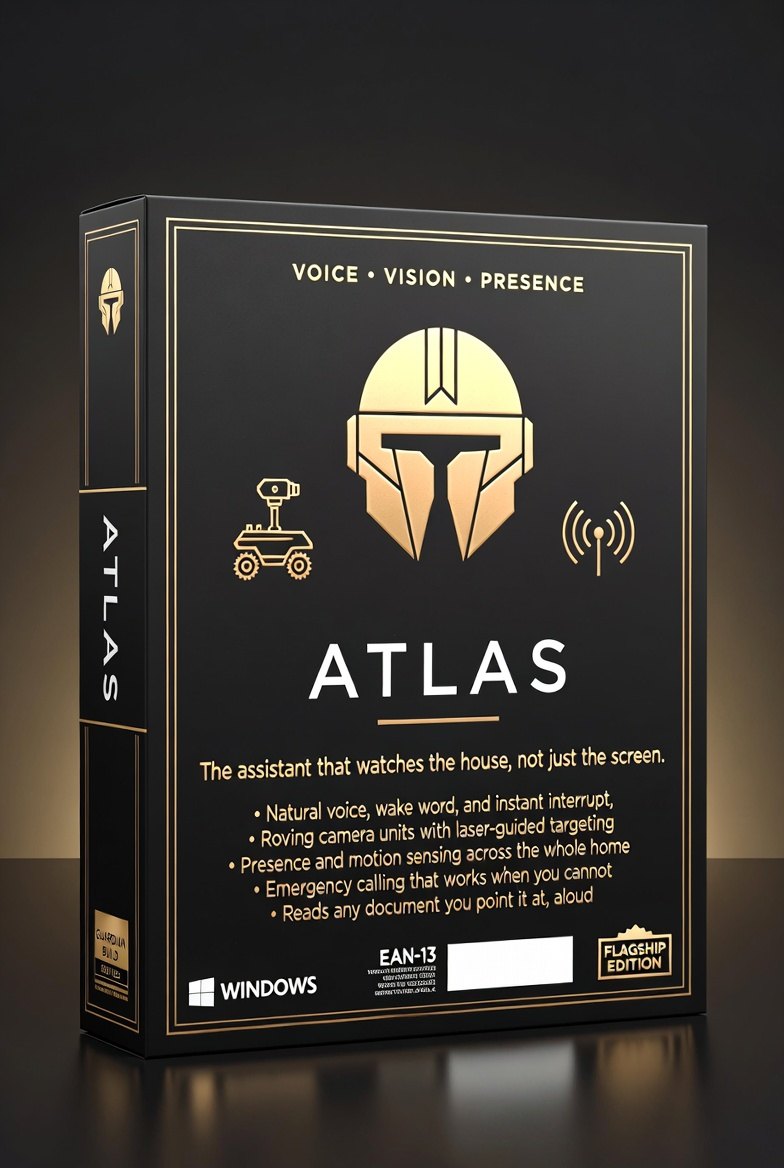
Atlas began as a voice assistant and became something broader: a system that listens, sees, and knows whether anyone is home. It runs on the operator's own hardware, with the conversational layer handled by a language model and the guardian and safety functions kept as deterministic local code that does not depend on a network connection to behave predictably.
The design intent is personal rather than commercial. It is built for someone living alone in a rural county with mobility and vision limitations, where the distance to help is measured in tens of miles and a fall in the wrong room is a different kind of problem than it would be in a city.
Wake-word interruption, voice cloning, live camera preview, and read-anything document handling are working today. Point it at a file and ask it to read it, and it will — images through vision, PDFs as native documents, ordinary text extracted locally. The longer roadmap adds a roving platform with LIDAR, millimetre-wave presence detection, and an independent emergency-calling path that does not rely on the main computer being awake.
Nothing here is offered as a medical or emergency-response guarantee. A camera can be blocked, a network can fail, and an automated call may not be accepted. Those failure modes are designed for rather than ignored.
- PlatformWindows desktop, Python voice core, .NET tray control
- InterfaceWake word, continuous speech recognition, cloned voice output
- VisionLive webcam preview and document reading
- StatusWorking daily; roving platform still on the bench
Every project in one place.
This is one of thirteen. The rest — desktop applications, web platforms, security tooling and games — are on the projects index.