
Codex Watcher
Turns an AI account into an organised team member.
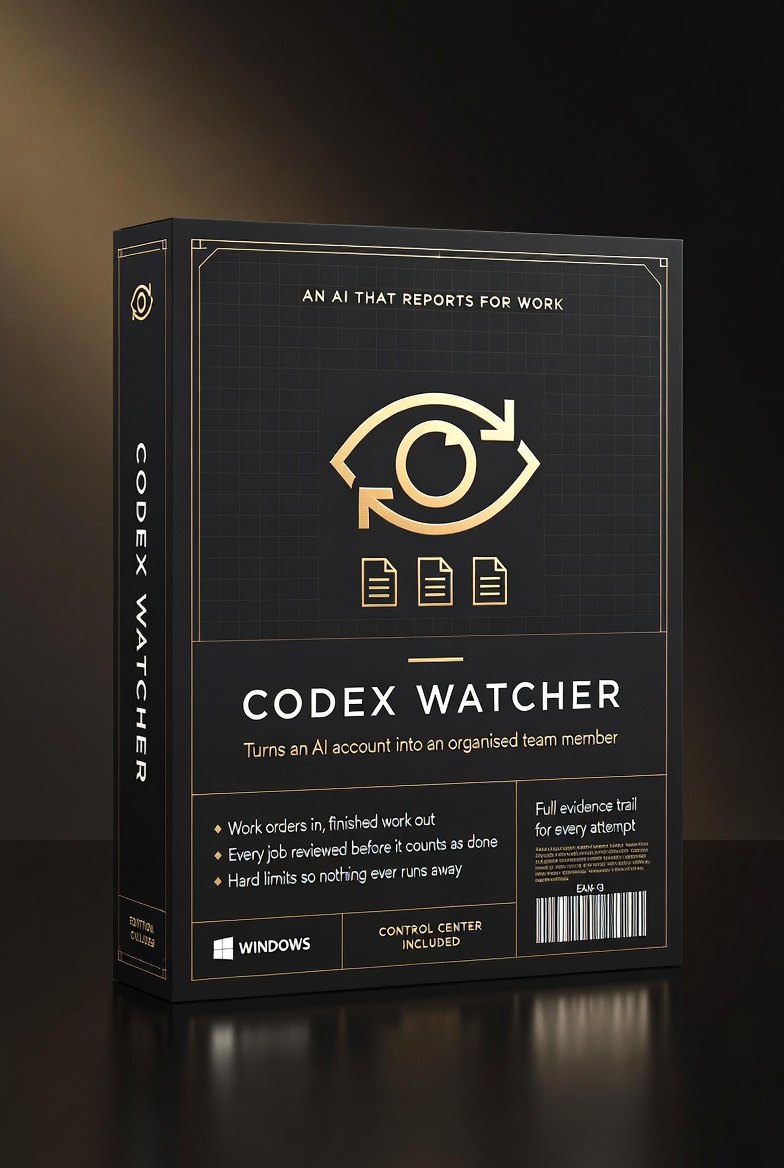
An AI account on its own is a chat window. Codex Watcher turns it into something that reports for work: engineering work orders go into a queue, an executor picks them up, and nothing counts as finished until it has been through review.
The interesting part is not the automation, it is the governance around it. Every attempt writes evidence — what was asked, what was produced, what failed and why. Token and turn ceilings are enforced at the process boundary rather than suggested in configuration, because an executor without a hard limit will eventually find a loop and run it. Work that fails is preserved rather than discarded, and a job may not silently overwrite an earlier attempt's evidence.
It does not make AI output automatically trustworthy. It makes AI output reviewable, repeatable, and attributable, which is a different and more useful claim.
- PlatformWindows service plus a control-centre desktop application
- ModelWork order in, reviewed artefact out
- ControlsPer-attempt, per-session and per-day usage ceilings
- CompanionClaude Watcher, a second executor on the same queue
Every project in one place.
This is one of thirteen. The rest — desktop applications, web platforms, security tooling and games — are on the projects index.